

Parasitic Zoonoses
When a parasite that usually resides inside or on an animal’s body causes a disease in human beings, the disease caused by it is known as parasitic zoonosis. There are many types of parasites that reside in and on animals’ bodies. Pet animals like dogs and cats also have them and can become an important source of transmission of these parasites to humans if not taken good care of.
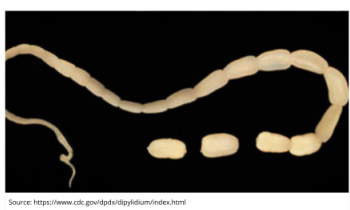
Dipylidiasis
Dipylidiasis is a zoonotic disease of dogs and cats and it occurs very rarely in humans. The parasite causing this disease is known as Dipylidum caninum. Dogs are usually the final hosts of this disease and fleas are intermediate hosts. Humans can acquire this disease by fecal-oral transmission. This disease is more common in kids who have pets and they regularly kiss and touch them. It is distributed worldwide and has been reported in different countries like Africa, Australia, Argentina, China, India and Japan. This disease is more common in children younger than 8 years. Age, sex and breeds are not associated with the prevalence of this parasite.
This disease can be spread by the ingestion of the vector (fleas in this case). This ingestion can be via the fecal-oral route.
In humans-
- The mild infections are mostly asymptomatic.
- Abdominal pain with or without diarrhea.
- Pruritis or rashes may occur.
- Increased irritability in children.
In animals-
- Anal pruritis
- Scraping anal region
- Mild abdominal disturbances
- Presence of larvae in the feces
- Examination of stools.
- Proglottids may adhere to perianal hair and be visible as yellowish-white substance once dry.
- Control fleas on your pet animals.
- Get your pets treated for tapeworms.
- Clean up after your pets.
- Do not allow children to play in soiled areas.
- Teach children to wash their hands after playing with dogs and cats.
- Children should not be allowed to put their hands in the mouth after playing with animals.
Sources:
- https://www.google.com/url?sa=t&rct=j&q=&esrc=s&source=web&cd=&cad=rja&uact=8&ved=2ahUKEwi6i8fNoa3yAhU2wjgGHXpcBsAQFnoECAUQAQ&
- https://www.cdc.gov/dpdx/dipylidium/index.html
- https://emedicine.medscape.com/article/216184-clinical
- https://web.stanford.edu/group/parasites/ParaSites2006/Dipylidiasis/Body.htm