
One Health
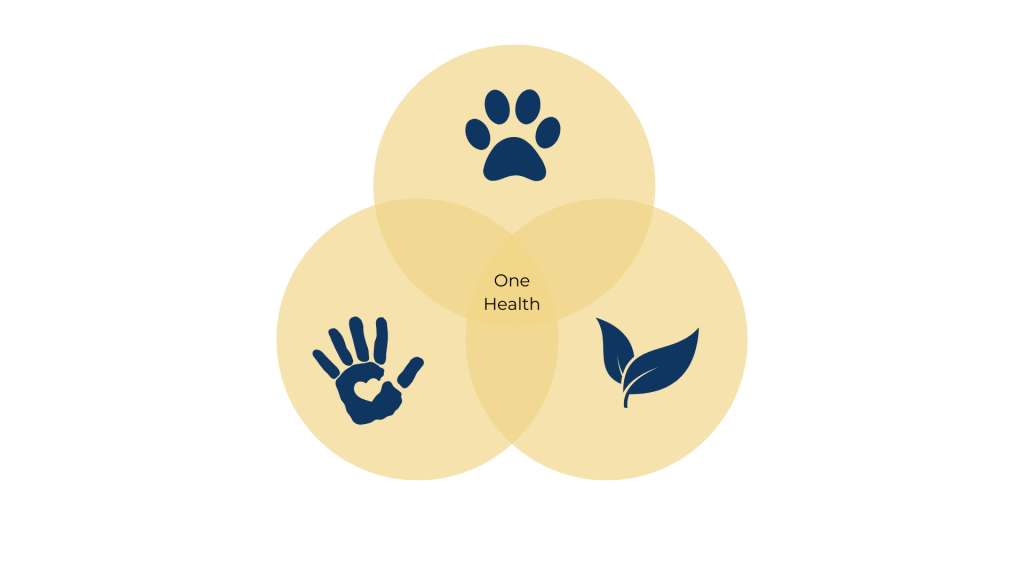
The epidemiology of zoonotic diseases is very complex due to the involvement of numerous animal reservoirs, and variation in the transmission dynamics. Risk of zoonoses at the animal-human-ecosystem interface is rampant. The United Nations Food and Agricultural Organization (FAO), World Health Organisation (WHO) and World Organization for Animal Health (OIE) are working in collaboration to address these risks at the human-animal-ecosystem interface. This is known as Tripartite Concept on the shared responsibilities for addressing health risks through multi-sectoral collaboration. Recently, this concept has gained momentum as One Health approach to combat health risks.
According to the CDC, One Health is a collaborative, multi-sectoral and trans- disciplinary approach- working at the local, regional, national and global levels with the goal of achieving optimal health outcomes recognizing the interconnection between people, animals, plants, and their shared environment. In the context of zoonoses and food safety, it has been well understood that human health is linked to animal health. Distinguished scientists like Robert Koch, William Osler, Rudolph Virchow and Calvin Schwabe demonstrated the collaborative links between animal and human health. One health bring together human, animal, and environmental health.
The concept of One Health does not have one specific origin. It is a constantly evolving concept fulfilling the needs that are realised as and when they are born. However, this concept was officially accepted in the year 1984 by various international organisations and scholarly bodies. This concept aims to bring people from all diversities (professional or racial) together to tackle the challenges faced by the health sector. These people include veterinarians, doctors, environmentalists, academics and many more. The constantly increasing interactions between people, ecosystems and animals are bound to create consequences and it is a well-known fact that these consequences are inter-related. One Health is a broad term that defines numerous sub-categories like bioterrorism, zoonotic diseases, psychological bonds between humans and animals, environment. It throws light on habitat destruction, invasive species, over population, over harvesting, consuming economies, etc.
One health approach has practical solutions for prevention and control of zoonoses. Hence, it is necessary to examine and understand the health across all species in depth, science behind these diseases, their effects on animals and public health and to devise newer methods to prevent and combat them. The benefits of One Health approach have been recognised by various countries as this approach addresses global health security.
In 2019, the Tripartite Zoonoses Guide (TZG) was jointly developed by the FAO, OIE, and WHO to support countries in taking a multi-sectoral, One Health approach to address zoonotic diseases. It provides principles, best practices and options to assist countries in achieving sustainable and functional collaboration at the human-animal-environment interface.
In India, several path breaking initiatives are underway to promote the concept of One Health. For strengthening One Health, collaborative and multi-disciplinary activities are jointly devised by the national agencies like Indian Council of Medical research (ICMR), Indian Council of Agricultural Research (ICAR), Department of Biotechnology (DBT) etc. The successful implementation of the One Health model involves integration and collaboration between multiple sectors of agriculture, animal health, and human health.